



So you’ve decided Invisalign clear aligners might be right for your smile. Smart move! But during your research, you’ve probably come across something called “attachments” and wondered what they’re all about.
Invisalign attachments are small, tooth-colored bumps made from dental composite resin that bond directly to specific teeth during treatment. They give your aligners something to grip onto, allowing precise force to move teeth into proper position. Each attachment is custom-shaped for your individual tooth movement needs.
Think of attachments as tiny helpers working behind the scenes. They give your aligners something to grip onto, allowing them to apply targeted force exactly where your smile needs it most. Each attachment varies in shape, size, and placement based on your tooth movement needs. And here’s the encouraging part: they’re designed to blend with your natural enamel, so they’re far more discreet than you might expect. Many Lafayette and Opelousas patients are surprised at how subtle they look once bonded in place.
How Do Invisalign Attachments Work?
Your aligners snap onto these attachments like puzzle pieces clicking into place. This connection lets your trays deliver precise pressure to specific teeth, making movements that would otherwise be tricky or even impossible with aligners alone.
Attachments enable complex tooth movements, including:
- Rotations: turning teeth that are twisted out of position
- Intrusions: pushing teeth up into the gumline
- Extrusions: pulling teeth down from the gumline
- Tilting corrections: adjusting the angle of leaning teeth
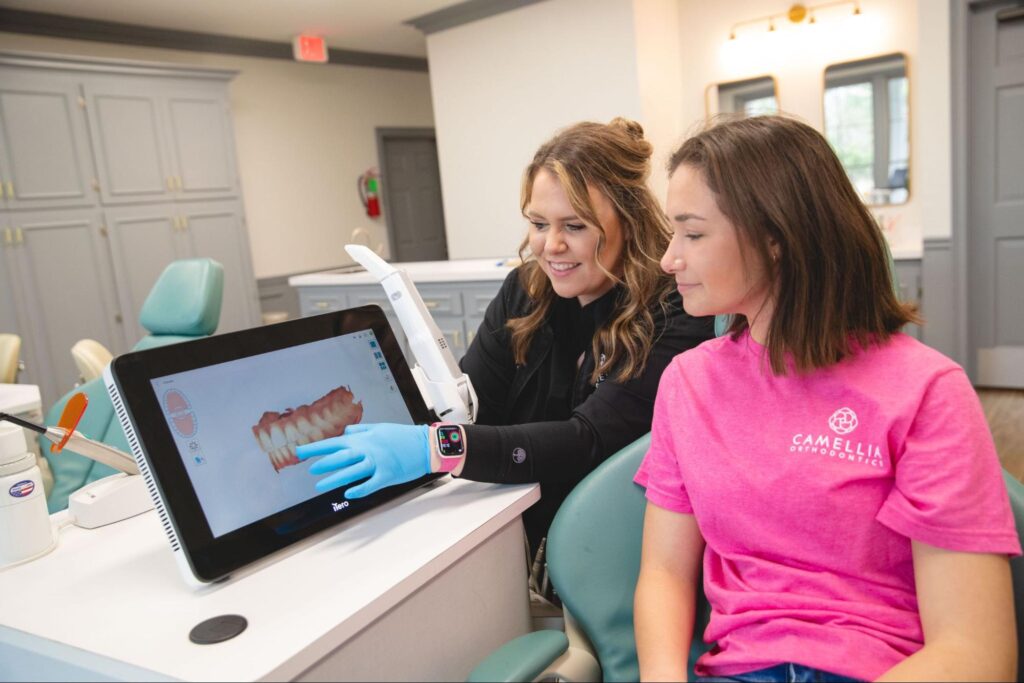
Here’s how the process works. Dr. Diana Bozner uses your digital treatment plan to determine exactly where each attachment should go. Every shape is custom-designed for your specific case. At your bonding visit, a template tray helps position each attachment accurately. The whole process is usually quick and comfortable.
Your attachments stay in place throughout treatment. If one happens to come loose, the team at Camellia Orthodontics can re-bond it and keep your treatment moving forward.
Why Are Invisalign Attachments Necessary?
Invisalign attachments are necessary because they allow aligners to perform complex tooth movements that smooth plastic trays alone cannot always achieve. By creating textured contact points, attachments help clear aligners apply better grip, direction, and control. Years ago, aligners worked best for minor cases. Today, they can handle a wider range of orthodontic needs when properly planned and monitored.
Here’s what attachments make possible:
- Better aligner retention: Your trays stay seated properly instead of lifting away from the teeth
- Predictable tooth movement: Each tooth can be guided more precisely
- Improved final transformations: Your smile has a better chance of tracking with the planned result
- Efficient treatment progress: Aligners can work more effectively at each stage
- Expanded candidacy: More patients may be able to choose Invisalign instead of traditional braces
Without attachments, aligners may slide over smooth tooth surfaces without enough traction for certain movements. The attachments create grip points that help your treatment work as planned. In many cases, attachments are essential to achieving the predictable results patients expect from clear aligner treatment.
If you are comparing clear aligners with braces, our Treatment Options page can help you understand the different ways orthodontic treatment can be customized.
Invisalign Attachments vs. Braces Brackets: What’s the Difference?
People often ask how attachments compare to traditional brackets. Fair question! They serve similar purposes but work quite differently. Invisalign attachments and braces brackets differ in material, visibility, and treatment system, as shown below.
| Feature | Invisalign Attachments | Braces Brackets |
|---|---|---|
| Material | Tooth-colored composite resin | Metal or ceramic |
| Size | Small and subtle | Larger and more visible |
| Visibility | Blend with enamel | Noticeable on teeth |
| System | Work with removable aligners | Fixed with archwires |
| Dietary restrictions | None when aligners are removed to eat | Avoid hard, sticky foods |
| Cleaning | Remove aligners to brush normally | Brush around fixed brackets |
Both systems apply controlled force to move teeth. The mechanics simply differ. Brackets use wires threaded through them to create tension. Attachments give aligners grip points for pressure.
If you are still deciding between aligners and braces, you can compare options on our Invisalign Lafayette, Clear Braces, and Metal Braces pages.
Do Attachments Affect the Cost of Invisalign?
Attachments are typically part of the overall Invisalign treatment plan rather than a separate decision patients make on their own. Your overall Invisalign cost depends on case complexity, treatment length, and the type of movement your teeth need, not simply the number of attachments placed.
Someone with more attachments does not automatically pay more than someone with fewer attachments. The treatment plan as a whole determines pricing.
If an attachment falls off mid-treatment, replacement is usually handled as part of ongoing orthodontic care. Lafayette and Opelousas patients often ask about cost ranges, and the most accurate way to understand pricing is through a consultation based on your specific smile goals. You can also review our Financing & Insurance page for more information about payment options.
Will I Need Attachments for My Invisalign Treatment?
Many Invisalign patients need at least a few attachments for the best results. That said, every smile is different.
You might need fewer or no attachments if:
- Your case involves only minor crowding
- You need simple spacing corrections
- Your teeth require mostly straightforward movements
You may need more attachments if:
- Your teeth require rotation
- You have bite issues that need correction
- Your case involves complex movements in multiple areas
At Camellia Orthodontics, Dr. Bozner determines attachment placement during digital treatment planning. She can show you where they may go and explain why each one matters for your specific case. The number and location are unique to your smile goals.
If you want to learn more about aligner care and treatment expectations, visit our Lafayette Orthodontic Services or Orthodontics for All Ages pages.
Frequently Asked Questions About Invisalign Attachments
Are attachments visible when wearing aligners?
Invisalign attachments are mostly hidden when you wear your aligners. Your aligner covers the attachments, so they’re not obvious. When your trays are out for eating or cleaning, you might notice small bumps on certain teeth. Most people won’t notice unless they’re looking closely.
Do attachments hurt?
The bonding process itself is comfortable and quick. You might feel mild pressure for a day or two as you adjust to the new texture on your teeth. Some patients notice their lips or cheeks feel the bumps initially, but this fades quickly.
When are attachments removed?
Attachments are removed at the end of your treatment. Your orthodontist gently polishes them off your teeth. The process is usually quick and comfortable, and your enamel remains intact underneath.
Can attachments fall off?
Attachments can occasionally come loose. Biting into something hard or sticky might dislodge one. If this happens, there’s no need to worry. Contact your orthodontic team and they can let you know whether a quick re-bonding visit is needed.
How should I clean teeth with attachments?
Cleaning teeth with attachments requires gentle, thorough technique. Brush carefully around each bump using a soft-bristled toothbrush. Take your time. Floss daily as usual. Some patients find a water flosser helpful for cleaning around attachments thoroughly.
Will attachments stain?
Attachments can pick up stains over time because the composite material may absorb color from certain foods and drinks. To help them blend with your enamel, limit staining drinks like coffee, tea, and red wine when possible. Always remove your aligners before eating or drinking anything besides water.

Curious whether Invisalign might be right for your smile? Camellia Orthodontics offers world-class service with a hometown feel, and Dr. Diana Bozner would love to answer your questions about Invisalign attachments and treatment options.
To continue learning, visit our Invisalign, Invisalign Lafayette, Lafayette Orthodontics, Orthodontist Lafayette LA, Treatment Options, Free Consult, and Contact Us pages.